Posts Tagged With: Uncategorized

Cities Can Cost Effectively Start Their Own Utilities Now

I don't think PG&E ratepayers understand how much higher the rates they pay are than what it actually costs PG&E to generate and transmit the electricity to their house. The average PG&E electricity charge now starts at 40 cents per kilowatt hour and goes up from there. Silicon Valley Power, Santa Clara's utility company, is getting power to customers for 17 cents per kilowatt hour. Sacramento's utility company charges about the same.

PG&E's rates are now high enough that it's completely feasible for cities to create their own utility and undercut PG&E's rates. I believe it is imperative for them to do so.

Here are the basic components of how much it costs to get electricity to your house.

  • Generation: The cost to actually generate the electricity in a power plant or utility-scale solar farm. This varies by time of day but typically costs about 4 cents per kilowatt hour; you can see the current wholesale rate on the CAISO website.

  • Transmission: How much it costs to move the power from the power source to a local substation/transformer, over large transmission lines. PG&E breaks this out in its detailed rate chart at about 4 cents per kilowatt hour.

  • Distribution: How much to get the power from your local substation to your house over local power lines. In PG&E's rate chart, they charge about 20 cents per kilowatt hour for this. for this. It just does not match up with how much it actually costs them to transmit power over local lines.

  • Everything else: Operations, maintenance, profit. This is where PG&E is actually seeing large expenses, because their coverage area is massive, it costs a lot of money to deliver power to rural customers, and they are also undertaking a massive project to underground utility lines in fire-prone areas.

This has a number of bad effects.

  • People really hate inflation. When utility bills spike, it makes people unhappy and also fuels the (not incorrect) perception that California is poorly governed.

  • Lower income people spend a higher percentage of their income on electricity, so higher utility bills disproportionately hurt them.

  • The net effect of charging higher rates to everyone to pay for undergrounding is that people who live outside of wildfire zones are paying more money to subsidize people who live in $2 million houses in places like the Berkeley and Orinda hills. This makes no sense.

  • Energy sources compete. Higher rates for electricity make electricity less competitive vs. gasoline when people are considering a car purchase. It makes electricity less competitive vs. natural gas for heating a house, heating water, or choosing a laundry machine. As gas is warming the planet and electricity is substantially easier to generate in abundance from renewable sources, it's just bad policy to have high electricity rates.

The good news is that PG&E's rates are so high now that it should be feasible for cities to start their own utility and undercut them. Let's walk through what this might look like for a particular city, I will pick Walnut Creek because it's a reasonably big city with a good mix of detached homes and multifamily. Walnut Creek also has experience with public ownership of amenities - the City operates a golf course and a downtown parking garage with ground floor retail.

There are a number of particular problems with applying PG&E's rates to Walnut Creek:

  • Walnut Creek is an urban area with a compact footprint that has little acreage in a high severity wildfire zone. It has two transmission lines as well as a local transformer grid along Ygnacio Valley Road. It is very cheap to transmit power from power plants to Walnut Creek, and from transmission lines to every house in Walnut Creek.

  • Walnut Creek has an above average number of apartments. Apartments do not have as much space for rooftop solar, and landlords don't have an incentive to provide rooftop solar because they typically pass through utility costs. This means NEM1 and NEM2 subsidies - 12% of the average non-solar bill - disproportionately hurt Walnut Creek renters.

  • Businesses have disproportionately high energy costs. Safeway and Whole Foods need to keep a row of refrigerators and freezers running 24/7. When they pay PG&E's rates to do that, those high energy costs are passed through as higher food prices.

Usage and Revenue

Palo Alto's total electric consumption was 830 gigawatt hours in 2024 - 19% of this usage was residential, and 81% was businesses and industry uses. Applying some adjustments for Walnut Creek - our population is bigger, it's a bit hotter here, and energy use has increased - let's say Walnut Creek uses about 1150 gigawatt hours per year.

Palo Alto earned $172 million in revenue for 830 gigawatt hours, which is about 20 cents per kilowatt hour.

Expenses

We are going to adapt Palo Alto's income statement, found on page 50 of their annual report, to Walnut Creek's situation. For each category, I am going to try to shade the numbers assuming we can't be as efficient as Palo Alto.

Acquisition of the network and financing cost

The first thing you need to do is buy out PG&E's distribution network - all of the power poles and local equipment that sits between the transmission lines and people's houses. San Francisco proposed buying this for $2.5 billion in 2019; PG&E rejected this offer for being too low. Adjusted for inflation and Walnut Creek's population, this is about $230 million, let's round up and say $350 million. Let's also assume it costs $50 million in startup costs and one time expenses to hire utility staff, buy equipment, marketing expense.

Cities with an AA credit rating can issue a 30 year loan at about 4% interest. Borrowing $400 million would cost about $23 million per year in interest and principal payments.

$23 million per year of financing cost spread across 1150 gigawatt hours is only about 2 cents per kilowatt hour.

Generation and distribution

Palo Alto spent $114 million buying energy in 2024, about 14 cents per kilowatt hour. Let's assume Walnut Creek can get power for about 17 cents per kWh.

Operations

This covers customer service, financial management, billing, engineering work for maintenance (tree trimming etc), and resource management. Palo Alto spent $65 million on these expenses in 2023. Let's assume Walnut Creek's costs are much higher at $90 million per year. This is about 8 cents per kilowatt hour.

Capital Improvements

Another $25 million per year is allocated for grid modernization, undergrounding, and reliability work. Let's assume this is $35 million per year for Walnut Creek, which would be about 3 cents per kilowatt hour.

Total

Adding this up, we get 30 cents per kilowatt hour, which is ten cents lower than PG&E's base rate and about 15 cents lower than PG&E's blended rate. At 1150 gigawatt hours, this would save Walnut Creek residential ratepayers about $23 million per year in total, about $800 per ratepayer, and Walnut Creek businesses about $92 million per year. That is a huge amount of money that could go toward much more productive uses - paying higher salaries, lowering prices for goods, spending more at local businesses.

Most elected officials would jump at the chance to mail every household a $800 check every year. The next best thing is to put $800 back in their pocket.

Other Benefits for Walnut Creek

There are huge ancilliary benefits for Walnut Creek to running its own utility network.

  • Easier and cheaper infrastructure upgrades: Public safety is a large concern in Walnut Creek. Things like installing new streetlights can take a substantial amount of time. PG&E took over nine months just to turn on the power for a crosswalk in Berkeley. With local control of the utility, Walnut Creek can prioritize investments in things like streetlights or HAWK signals.

  • Green infrastructure investments: Walnut Creek has made sustainability a key priority. Palo Alto owns a share in a hydroelectric dam, and Santa Clara owns a share in a geothermal plant. At a time when there are exciting new technologies that have the potential to reduce greenhouse gas emissions and deliver clean, cheap energy to residents - things like Fervo Energy that use the tech behind fracking to deliver geothermal power - Walnut Creek can use its very low cost of capital to finance these investments. This is something PG&E cannot do as effectively because as a public utility with huge liability, their cost of capital is much higher. Public ownership would enable transformative green energy investments.

  • Encouraging the green transition: A 25% reduction in the cost of electricity relative to natural gas would make electric upgrades like heat pump water heaters or electric cars much more financially prudent investments.

  • Fiscal stabilizer: Like every city in California, Walnut Creek has boom and bust cycles. Utilities have much more stable revenues than cities. Walnut Creek could borrow from its utility in recessions, and loan money during booms.

  • Encourage incorporation: Walnut Creek has a number of unincorporated pockets (San Miguel CDP, Shell Ridge CDP) that administratively make little sense - they are served by different police, they have different tax rules. If these homes could save $800 per year on their utility bill by joining Walnut Creek, this may provide an incentive to incorporate, which would ultimately lead to better governance.

  • The best alternatives are good: PG&E is terrified of cities leaving its service network. Look at the concessions they are offering to South San Jose to try to prevent them from starting their own utility.

    Even if Walnut Creek doesn't ultimately pursue its own utility, just investigating the possibility may lead PG&E to offer concessions such as undergrounding the transmission line over downtown. Because you can't build under a transmission line, this makes a 100 foot wide swath of very valuable land undevelopable. St. Paul's would love to redevelop its parking lot under the transmission line for affordable housing, but can only develop tiny corners of the lot with the transmission line overhead. Undergrounding the line would deliver huge benefits to Walnut Creek.
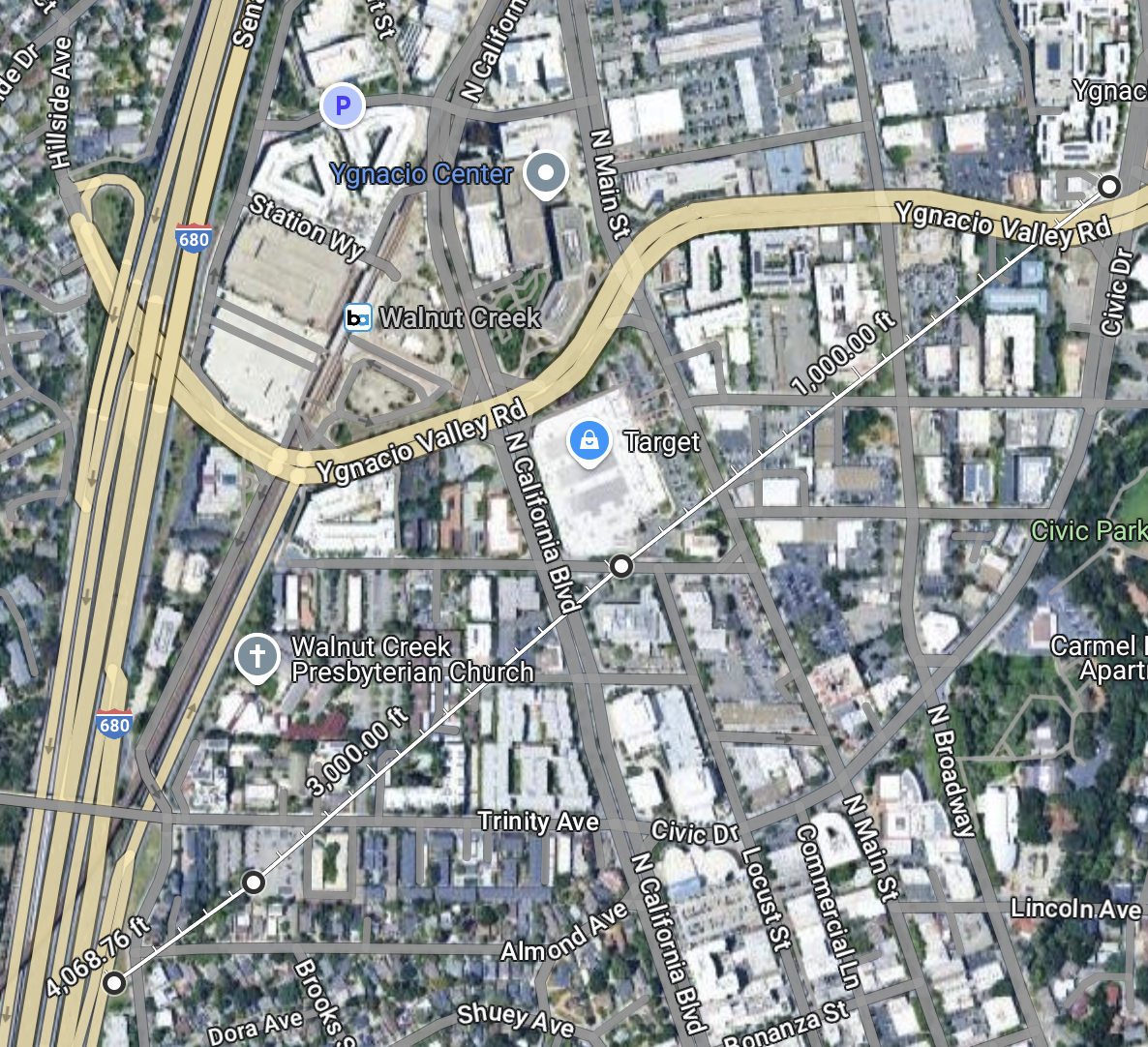
    Transmission
line over downtown Walnut Creek

  • Lowering the cost of urban living in safe places: PG&E's current rate structure has urban rate payers subsidize rural rate payers and people who live in wildfire zones in e.g. the Orinda Hills, who need substantial investment in order to receive power without sparking wildfires. This is bad policy - instead of subsidizing fire zones, it should be cheap to live in safe places and more expensive to live in dangerous places. Lower cost of electricity would reverse these trends.

California is kneecapping its own climate transition with high electricity prices. The resulting inflation hurts our state's ability to retain a high class, diverse workforce. Perversely, it also serves as a subsidy to wildfire zones at the expense of infill areas. It's time to reverse those trends and deliver lower energy prices in places we want more Californians to live.

Liked what you read? I am available for hire.

housing post

Bay Area Tech Worker? Here's Why You Should Care about SF Politics

Do you work in the tech industry in the Bay Area? You should start learning about, and getting involved in, local housing politics.

The prognosis for housing and rent prices is bad, and things are likely going to get worse for tech workers in the Bay, unless we start taking action. I will explain why prices will keep going up, and what you can do to help.

Why Should You Care?

Salaries in the tech industry are really good! Rent may be high, but you make more, and can count on raises to outpace rent increases. Why should you care?

  • You may want your children to be able to afford to live where they grew up. Thirty years ago, you could buy a house in the Bay Area for 3-4x the average income. Frequently now that number is 8-10x, and that house may be out in Antioch.1

  • San Francisco has a huge number of people commute downtown every day, which stress our highways and tunnels. Long commutes are correlated with lower happiness, and are more harmful for the environment. If we built more housing near where people work, commutes would be shorter.

  • Lower rents mean that there's more money in your pocket.

  • You may want to buy a home, and you may not have rich parents, or have been an early employee at a rocketship startup.

  • Cheaper housing helps less fortunate people make it and get a leg up. The Bay Area has one of the tightest job markets and most dynamic local economies in the US. People not making very much in other areas can move here, get a job and earn a higher salary than they can in, say, Reno. The high starting prices for housing discourage this, which means it's more difficult for the middle class to get a foothold in the Bay Area.

  • You may want to send your children to school in the area. Schoolteachers largely can't afford to live in San Francisco, which makes it harder to recruit good teachers for your kids, in public or private schools. Your employees have this same problem.

  • If you want to start a company, you'll need to hire employees. Higher home prices and rents mean that you have to pay higher salaries and more for rent. This makes your startup less viable.

  • If you want to fund startups, high salaries and rents mean you have to have larger rounds, and that your money doesn't go as far.

How an Empty Plot of Land Becomes Housing You Can Live In

You have to jump through many hoops to build housing in San Francisco. This section is long, but it's important to know how many different opportunities there are for NIMBY's to stall a project they don't like.

  1. Buy land you want to develop on. There are many underdeveloped properties in San Francisco - parking lots, unused office spaces, or undeveloped lots owned by the City.
  1. Submit a building plan to the City that follows the zoning code. Put up signs in the neighborhood explaining what you are building. Start working on permits. This part is pretty standard across all cities.

    If your property is on the waterfront, your project needs to be approved by a majority of city residents in the next citywide election, thanks to 2014's Proposition B, which requires any new waterfront development to be voted on by the entire city. If you want to build in SOMA or the Mission and your housing would replace a production, distribution or repair business, you need to create one elsewhere or add space in your building for it, thanks to 2016's Prop X.

  1. You have to submit an "Environmental Impact Report" (EIR) which explains the environmental impact your building will have. There were over 200 different "impacts" that can be considered - noise, traffic, crime, etc. All of these were given equal weight until a few years ago. These "impacts" are local to the area — you can't count "People will have to commute from Stockton if we don't build in SF" as an impact, even though it's true, and bad. Most of the time, you can reuse an existing Environmental Impact Report that has been prepared for a given neighborhood. More on this later.

  2. If a neighbor doesn't like your project, they can pay just $578 to ask for a "Discretionary Review" by the Planning Commission. This is supposed to be for extraordinary circumstances, but pretty much anyone can file for any reason. Common ones are because a project will block your view, will cast a shadow on your beer garden, won't fit with "the character of the neighborhood," or requires a "variance," some small change from the zoning code.

    You are supposed to meet with the community at this point. Your neighbors probably won't like your project. They may invoke the words "3 story monstrosity" to describe it, pass around flyers saying it will "ruin neighborhood character", or say there will be increased crime, a harder time finding parking, etc. If they can't block the project, they want you to make it shorter and smaller. But resolving the issue by reducing the number of units makes your project less viable.

    If you can't resolve the issue it goes to the Planning Commission, which has seven members, four of whom are appointed by the Mayor, three by the City Supervisors. You get ten minutes to explain why you should be allowed to build. The opponents get ten minutes to complain about their views. There is a "public comment" section where members of the public get 2 minutes to talk about the project.2

    The Planning Commission may ask you to compromise, approve the project, deny the project, or punt the decision by a month. They frequently deny projects. Let's say they approve the project. Hurray!

  3. Your neighbors may appeal the decision to the full Board of Supervisors. There are 11 supervisors, one for each district in San Francisco. The Board is currently split between people who want more housing and people who say they want more housing, but repeatedly vote for rules that make it harder to build housing.

    The most frequent appeal angle is to say that the EIR is not valid. Recently, one guy in the Mission appealed a 100% affordable, 94-unit building for senior citizens. You can read the appeal for yourself. The main reason the appellant thinks there should be a new EIR is because these poor senior citizens will cause vagrancy, crime, and littering in the neighborhood. Certainly these effects would be much worse if we didn't build the housing, and these seniors would be on the street.3

    You are about six to eighteen months into the permit process at this point. And the Board may vote to turn down your project! Recently a 157-unit project in the Mission, with 39 affordable units, was denied by the Board.

    Neighborhood groups may try to make a "deal" where the developer essentially buys their support. Calle 24, an anti-gentrification group in the Mission, recently negotiated a "deal" with another building where they would drop their protests in exchange for $1 million.

  1. At any time during this process your permit might run out, the bank might decide to cancel your loan, market conditions may change, the City might vote to make your project infeasible. This is why your neighbors use so many stalling tactics - the longer they can stall, the more likely you will pull out of the project.

  2. If the BoS approves your project, your neighbors have one more recourse: they can file a California Environmental Quality Act (CEQA) lawsuit. The lawsuit alleges, essentially, that a project would be harmful to the environment, and the developers haven't sufficiently considered those impacts.

    If you were considering the environment at a regional level, you would probably want to build as densely as possible, and optimize for short commutes - so you'd file lawsuits to block low density projects that build on undeveloped land. However, a recent study found that CEQA lawsuits target infill projects (which increase density) by a 4 to 1 ratio. CEQA is well intentioned, but frequently abused. In one instance, abortion opponents filed a CEQA lawsuit to block a Planned Parenthood. They said that the Planned Parenthood hadn't adequately considered the noise that the protesters themselves would generate!.

  3. Finally, if you navigate this intimidating gauntlet, and are determined to stick with the project, and your permits haven't expired, you can break ground on your project. It's extremely expensive to build here, and while the sums are large and the rent is high, developers do not make much money. One developer, Boston Properties, targets a 7% return, which is not large given the risk involved.

How does this work in places that keep prices low? States like Texas have lots of land and loose zoning codes. Other countries, like Japan, work around this by setting housing policy at the regional or national level. Essentially, they don't let NIMBY's have a say in the process.

Other Housing Errata

  • The city of San Francisco is half as dense as Brooklyn. We can achieve large decreases in rent prices by just building 4-5 stories on empty lots around the city.
  • If you live in a building that is older than 1979, you are entitled to rent control, which means that your landlord can only increase your rent by a few percent per year (the exact percentage is controlled by the SF Rent Board and tied to inflation. Last year it was 2.2%). You have a wide array of rights as a tenant; you may even have tenants rights if you have been living in a place for more than 30 days and don't have a formal contract with your landlord, or are not on the lease.

    Econ 101 classes will teach you that rent control depresses supply, but I don't think it's too relevant to the SF housing crunch. If we didn't touch a single rent controlled unit, and just built 4-5 story units on the underdeveloped lots around the city, we'd be in a great place, housing wise.

  • There are well intentioned people who believe that building new housing supply actually creates more demand, and show up to meetings opposing any new development. This theory is not borne out by the evidence; the city has built a ton of new housing since 2015, and as a result, market rate rents have fallen by about 5% since the peak of the market. Other cities like Denver and Seattle have also seen rent decreases in response to new housing coming on the market. Furthermore, if increased supply really increased demand, the opposite would also be true - reducing supply would reduce demand even further! But no one suggests that destroying housing in SF would lower prices.

  • There are well intentioned people who believe that the only new housing in SF should be 100% affordable. 100% affordable projects are not profitable or viable for private developers, so they require subsidies. There is only so much money for subsidies, and in addition the Trump administration is interested in cutting federal subsidies for affordable housing.

  • There are well intentioned people who believe that the only way to prevent gentrification is to prevent any new buildings from being built - groups like MEDA and Calle 24, who have successfully fought projects in the Mission. Blocking new supply doesn't do anything about high demand, of course, and the result is existing buildings getting resold for millions of dollars, as we're seeing in the Mission, and ordinary people can't find new places to live, or can't move within their neighborhood.

  • There are less well intentioned landlords and real estate agents who oppose new housing because no new supply drives up the demand for existing housing, which increases their property values.

  • The most frequent complaints are that a project has too many luxury units and that it's too tall. These complaints and process impediments drive up the price of building here, which mean that the only viable projects are (1) targeted at the high end of the market, and/or (2) contain lots of units. Ironically, the complaints about luxury and height make it harder to build projects that aren't very tall and very high end!

  • Construction unions often oppose projects (and sometimes file CEQA lawsuits to block them) if the construction wages aren't high enough, or if the developer wants to use non-union labor.

  • You can complain to the Planning Commission that a project will cause shadows or block your view. In 99% of the country, these disputes are resolved by buying an easement, a contract that prevents your neighbor from blocking your view or casting a shadow.

    The Coase Theorem says this should be good enough; if you don't have an easement, we can conclude your neighbors value building high more than you value your view or your sunlight. Except in San Francisco! If your neighbor doesn't want to grant you an easement, you can complain to the Planning Commission and block their project.

How to Get Involved

All of this means that building new housing is really difficult in San Francisco, and as a result, rents and home prices are going to continue to increase, you will pay more in rent, you won't be able to hire employees or buy a house, and your kids' teachers won't have a place to live.

The problem is that prices are too high and there are too many roadblocks to building. The political goal is to lower prices by a) building more, and b) making it easier to build more. I support pretty much every project - 100% affordable, super high end market rate - as long as it gets a shovel in the ground. Every new unit helps - even if it's not in your price range, it means people in that price range aren't outbidding you for a place in your range.

Things that don't work

  • Bitching on Twitter - This accomplishes nothing, as the last election showed. The same way Indivisible Team and others are encouraging people to show up to town halls and flood their reps offices with phone calls - you need to do this for your local supervisors. The good news is that your local officials pick up the phone! And they don't get as many calls, so they're more responsive to your phone calls.

  • Building an app - We are not going to hackathon our way out of the housing crisis. We need to show up to planning meetings and whip support for bills.

  • Apathy - The default mode for tech employees, which is to not care about local politics and then outbid other residents for apartments. As long as this is true homes will be unaffordable, your kids schools will have tired teachers and your rents will keep rising.

If you have 5 minutes a week

Calling actually makes a difference! Call your supervisor or state rep and ask them to support building more housing, and to make the approval process simpler.

  • The most pressing SF issue concerns the percentage of affordable units per new development. Two SF supervisors want to force all new developments to have 28% of units be affordable, which is unworkable for many projects - 28% of zero new projects means that zero new units get built. A competing plan would lower the percentage to 18%, which would increase the total number of affordable units, despite being a lower percentage, because it would make more projects viable. Call your supervisor and ask them to support the Breed/Safai Prop C plan.
  • The most pressing area issue is what will happen to an industrial park in Brisbane. A developer wants to build 4,300 apartments on empty land, but the city is fighting back. If you live in Brisbane, call the mayor's office and tell them you support the development, or show up to the nightly meetings.

  • The next election, figure out how the candidates stand on housing, and vote for the pro-housing candidates. This is tricky, because everyone says they are pro-housing, but many will not help get shovels in the ground. "Preserve neighborhood character" is a red flag. "100% affordable only" is a red flag. Any reference to wind tunnels, shadows, or height is a red flag.

  • Sign up for SF Do Something. Follow SFYimby or East Bay Forward on Twitter, and call your supervisor when you hear about a helpful piece of legislation, or a stalled housing project.

  • There are several bills in the California State Legislature that help. SB 35 (sponsored by SF's Senator, Scott Wiener) would make it more difficult to stall projects if cities are not meeting their state-mandated housing goals. SF's Representative, David Chiu, sponsored a bill to tax vacation homes and use the money to support affordable housing. SB 167 would make it harder for cities to block housing projects. Call your state senator and representative and ask them to support these bills.

If you have an hour a week (especially if your work hours are flexible)

SF Yimby holds meetings once a month teaching new people how to make a difference in their community; check their Facebook for notifications about the next meeting.

Show up to your local city hearings and speak in support of projects. The Planning Commission meets at City Hall every Thursday and posts their agenda here. You can show up and give a comment.

  • Take BART or MUNI to City Hall, a block from the Civic Center station.

  • Ask the City Hall door guard where the Planning Commission meeting is.

  • There are little cards at the front of the room. Write down your name, and check the box that says "Support."

  • Sit in the meeting. When the Commissioner asks for comment, line up by the microphone. Say you are a city resident, and you support building the project. Here is a template:

    Hi, I'm [name here], a [renter|homeowner] in District [your district]. I'm speaking in support of the project. We are in the middle of a housing crisis, and the more housing we build, the more people can afford to live here. This project will help [X number of people] live in the city, close to where they work, and should go forward. Thank you for your time.

The wild thing is that the commissioners and supervisors apply ad-hoc, per project guidelines and often vote based on how many people comment in support or in opposition of the project. So your voice really does matter! But you have to show up.

The meetings can take a long time. City Hall has good wifi; I've sat in the back of the room and worked for hours at a time before while waiting for a bill.

You can also write an email to the Planning Commission in support of a particular project.

If you work in SF and commute to a megacorp in the South Bay

Menlo Park, Palo Alto, Mountain View and co love to build office space, but hate to build housing. Consider calling the city managers in the city you work in, and ask them to support more housing, so you can afford to live near where you work.

Your C-level managers or venture capital backers may not realize how bad the problem is for employees. Ask them to support pro-housing candidates and organizations.

Ask your company to try to build apartments in the area; Facebook is trying this.

If you have money

The tech community is learning slowly that it's not enough to air drop cash three months before an election; we have to build organizations and coalitions, get elected to committees like the local DCCC, and show up to meetings between elections. Donate to these local pro-housing organizations:

  • CARLA sues cities that break California state law to deny proposed projects. This is a surprisingly effective technique that is already producing results throughout the Bay Area, but lawsuits are expensive.

  • [Yimby Action][yimby] is a pro-housing lobbying group.

  • East Bay Forward is focused on building housing in the East Bay.

  • Donate to local pro-housing candidates. Volunteer for their campaigns; knock on doors.

Conclusion

Demand for housing in the Bay Area far outstrips supply, but it's really hard to build here, and there are a lot of people and procedures that want to keep things expensive and scarce. If you want to ever afford to buy a house here, it's time to start getting involved.

1 This doesn't stop old people from showing up to planning meetings and saying "I worked hard and built a house here and these spoiled young people can too!" It's three or four times as difficult now as it was in 1970.

2The comment quality can vary widely - at one recent public comment section, a commenter worried what would happen to the "rare plants" on a vacant lot.

370% of San Francisco's homeless were homed in San Francisco before they were on the street; it's a very local problem.

Liked what you read? I am available for hire.